MicroSD Express: Why Nintendo Switch 2 Needs It
- By Olivia
- May 04,2025
Last week, Nintendo unveiled the much-anticipated Nintendo Switch 2, sparking excitement among gamers. A notable feature of the new console is its exclusive support for MicroSD Express cards for expansion. While this might be inconvenient for those with existing MicroSD collections, it's a forward-thinking move due to the superior speed of MicroSD Express cards.
These cards utilize the PCIe 3.1 interface, which significantly enhances read/write speeds to levels comparable to the UFS (Universal Flash Storage) used in the Switch 2's internal storage. This advancement means games stored on MicroSD Express cards can theoretically load just as quickly as those on the internal storage, although it does limit users to more expensive options.
MicroSD vs. MicroSD Express
MicroSD cards have evolved over the years, with speed ratings increasing from the initial 12.5MB/s of the first SD cards to the 312MB/s of SD UHS III. However, the introduction of the SD Express standard five years ago marked a significant leap forward. SD Express cards leverage the PCIe 3.1 interface, which is also used by high-speed NVMe SSDs, achieving data transfer rates up to 3,940MB/s for full-sized cards.
While MicroSD Express cards don't reach the top speeds of their full-sized counterparts, they still offer impressive performance, with speeds up to 985MB/s—three times faster than the fastest non-Express MicroSD cards.
Why Does the Switch 2 Require MicroSD Express?
Although Nintendo hasn't explicitly stated its reasons, the primary advantage of requiring MicroSD Express cards is their speed. With a game installed on both a traditional UHS-I MicroSD card and a MicroSD Express card, the latter's use of the PCIe 3.1 interface results in much faster load times. This trend might soon extend to handheld gaming PCs as well.
The Switch 2's internal storage has been upgraded to UFS from eMMC, aligning with the need for faster external storage solutions. Early demonstrations suggest significant improvements in load times for games like Breath of the Wild, with fast travel load times reduced by 35% according to Polygon, and a 3x improvement in initial load times as reported by Digital Foundry. These enhancements may be attributed to the faster internal storage, but could also be influenced by the console's improved CPU and GPU, which can process data more quickly. To ensure future games aren't hindered by slower storage, the use of MicroSD Express cards is a strategic move by Nintendo.
Moreover, this requirement paves the way for even faster storage solutions in the future. The current fastest standard for SD cards, SD 8.0 Specification, supports speeds up to 3,942MB/s for full-size SD Express cards. While MicroSD Express cards don't yet reach these speeds, they have the potential to do so in the coming years, provided the Switch 2 supports such advancements.
MicroSD Express Capacity Options
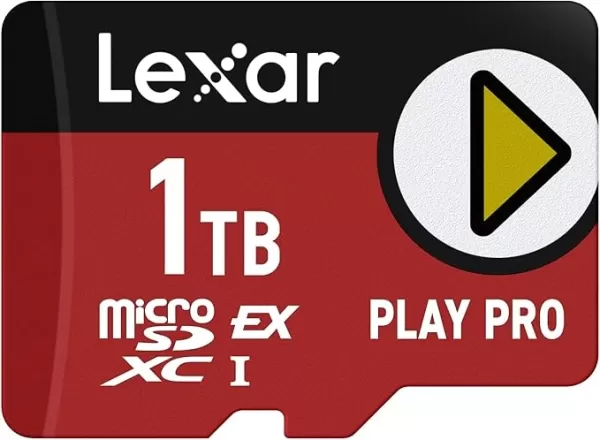
The adoption of MicroSD Express cards has been gradual, but the launch of the Nintendo Switch 2 is expected to accelerate this trend. Currently, options are limited. Lexar, for instance, offers a single MicroSD Express card in capacities of 256GB, 512GB, and 1TB, with the 1TB variant priced at $199.
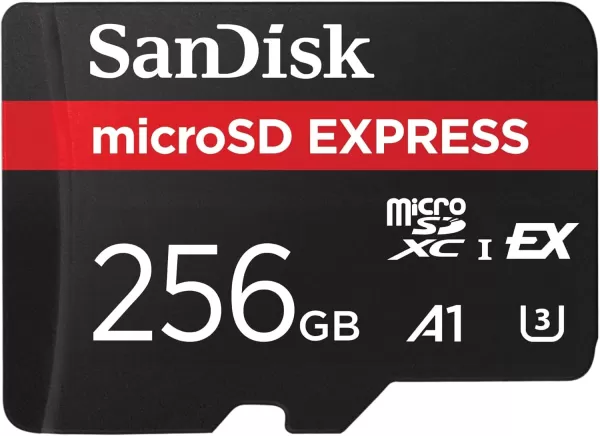
SanDisk, on the other hand, provides a MicroSD Express card with a maximum capacity of 256GB, which matches the internal storage of the Switch 2. As the console's launch approaches, we can expect a broader range of MicroSD Express cards to become available, likely expanding beyond 512GB as companies like Samsung enter the market.